

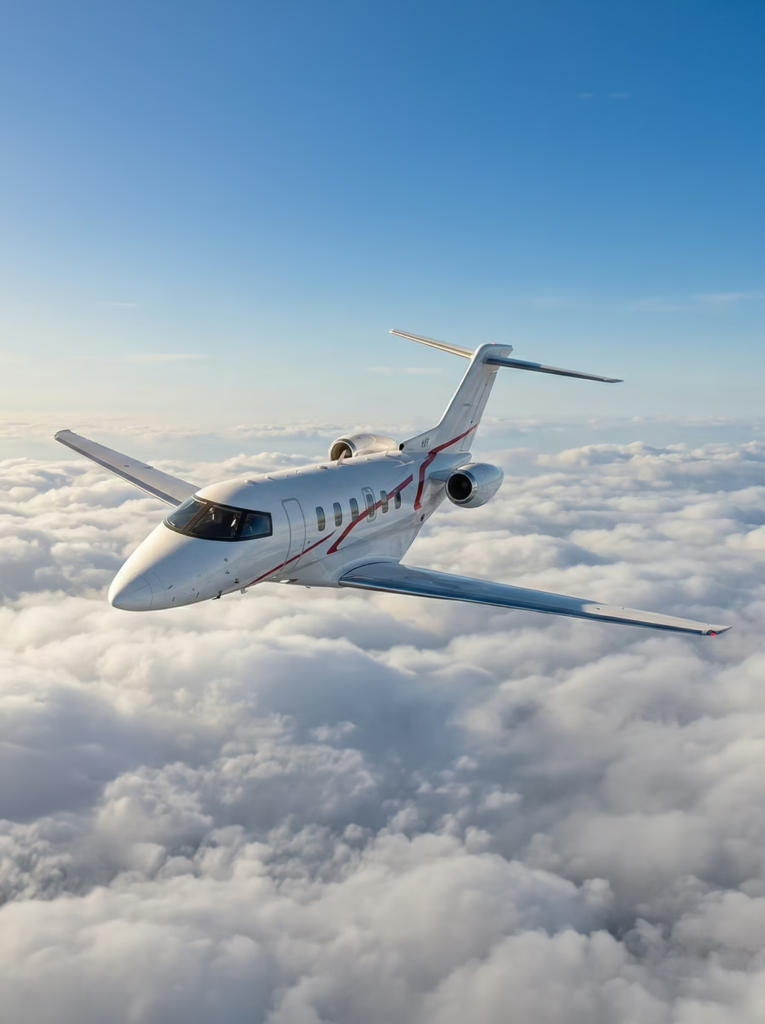
Yes, private jets can land at smaller regional airports that commercial airlines cannot serve. Because business jets require significantly shorter runways and have lower noise and weight footprints than commercial aircraft, they open up hundreds of additional airfields across Europe and beyond. The sections below explain exactly how that access works, what it means for your travel time, and which aircraft types are best suited to specific airfield types.
Which airports can a private jet access that commercial flights cannot?
Private jets can access thousands of smaller regional airports, altiports, and general aviation airfields that are entirely off-limits to scheduled commercial flights. While a commercial airliner typically needs a major international hub with long runways, ground infrastructure, and high passenger volumes to justify operations, a business jet can use compact airfields close to ski resorts, coastal towns, private estates, and secondary business districts.
In practice, this means flying into airports that sit far closer to your actual destination. Rather than landing at a major city hub and spending an hour or more on a ground transfer, a private jet can often put you down at a smaller field just minutes from your final stop. Airports serving ski regions in the Alps, coastal airfields along the French Riviera, and compact business aviation aerodromes near industrial or financial centres are all regularly used by business jets, but commercial airlines would never consider them.
The diversity of the FLYINGGROUP charter fleet is built precisely around this kind of access. Combining its own aircraft with carefully selected partner operators, FLYINGGROUP can match the right jet to the right airfield, whether the destination is a well-known European capital or a remote regional strip.
What runway length does a private jet need to land?
Most private jets can land safely on runways between 800 metres and 1,800 metres, depending on aircraft type, weight, altitude, and weather conditions. By comparison, a typical commercial narrow-body airliner requires at least 2,000 to 2,500 metres of paved runway. This difference in runway requirement is the single biggest reason private aviation unlocks so many more airports.
Runway length requirements vary meaningfully across jet categories. A light jet such as the Cessna Citation CJ series can operate from shorter strips of around 900 to 1,200 metres. A midsize jet like the Embraer Praetor 500 typically needs somewhat more runway, while a large or heavy jet such as the Dassault Falcon 900EX requires closer to 1,500 to 1,800 metres under normal conditions. Turboprops, such as the Pilatus PC-12, are the most flexible of all, capable of operating from unpaved or very short airstrips that even light jets cannot use.
It is important to understand that published runway length is not the same as guaranteed landing distance. The actual distance a specific aircraft needs on a specific day depends on its weight at landing, the elevation of the airfield, air temperature, wind direction, and the condition of the runway surface. A mountain airfield at altitude, for instance, requires more runway than the same strip at sea level because the thinner air reduces aerodynamic performance. Every flight is assessed individually by the operating crew to confirm that the runway is suitable.
YOUR NEXT JOURNEY STARTS HERE
Speak with our team about your private aviation needs.
How does landing at a smaller airport save time?
Landing at a smaller regional airport saves time in three compounding ways: shorter ground transfers to your final destination, no commercial terminal queues or security theatre, and faster turnaround at the aircraft. Together, these can reduce total door-to-door travel time by several hours compared to a commercial flight routing through a major hub.
The most obvious saving is geographic. When a private jet can land at an airfield 20 minutes from your hotel or meeting venue, rather than at a major international airport 90 minutes away, the ground transfer alone saves more than an hour each way. Over a multi-stop business trip, those savings accumulate quickly.
The second saving comes from the private terminal experience. At smaller general aviation airfields, there are no queues, no crowded departure halls, and no fixed check-in windows. You arrive at the aircraft, complete a streamlined security process, and depart on your schedule. Arrival is equally direct: you step off the aircraft and into your waiting car within minutes, with no baggage carousel and no passport queue in a crowded terminal.
The third saving is scheduling flexibility. Because smaller airfields handle far less traffic than major hubs, slot availability is rarely a constraint in the same way it is at congested international airports. That flexibility means your departure time is genuinely yours, not subject to air traffic management delays caused by commercial traffic volume.
Are there any restrictions on private jets using regional airports?
Yes, regional and smaller airports do impose restrictions on private jets, and these vary significantly from one airfield to the next. The most common restrictions involve prior permission requirements, noise limits, curfews, aircraft weight and size limits, and parking availability. Understanding these restrictions before booking is essential, because a slot or landing permission at one airfield does not automatically guarantee parking or overnight stay.
Prior Permission Required, commonly referred to as PPR, is one of the most important concepts to understand. Many smaller airports require operators to request and receive formal approval before a flight can land or depart. This is separate from an air traffic control slot, a noise waiver, and a parking confirmation, all of which may need to be secured independently and in advance.
Noise restrictions are particularly relevant at airports near residential areas or in environmentally sensitive locations. Some airfields prohibit jet operations during night hours, restrict the use of reverse thrust to emergency situations only, or apply noise quotas that limit the number of movements a particular aircraft type can make. Curfews at airports such as Paris Le Bourget, for example, restrict jet departures during certain overnight hours, which directly affects scheduling flexibility.
Aircraft weight and physical size limits also apply at certain smaller airfields. A runway that is physically long enough for a heavy jet may still be off-limits due to pavement strength ratings or taxiway width constraints. Specialist destinations such as mountain altiports add further complexity: Courchevel Altiport in the French Alps, for instance, has a very short, steeply sloped runway and is not suitable for standard light, midsize, or heavy jets. Access there typically involves flying to a larger nearby airport such as Chambéry or Geneva and completing the final leg by helicopter or car.
Working with an experienced operator means all of these factors are checked and confirmed before your itinerary is finalised. The FLYINGGROUP charter team handles PPR applications, slot coordination, and airfield suitability checks as part of the flight planning process, so clients never need to navigate these operational details themselves.
YOUR NEXT JOURNEY STARTS HERE
Speak with our team about your private aviation needs.
Which private jet size is best for accessing remote airfields?
Turboprops and light jets offer the greatest access to remote and shorter airfields. The smaller the aircraft, the shorter the runway it needs and the lighter its footprint on the ground, which directly translates into more destination options. However, the right choice always depends on the specific airfield, the number of passengers, the luggage requirements, and the distance to be flown.
Turboprops: the most flexible option
Turboprops are propeller-driven aircraft powered by jet engines, and they represent the most capable category for accessing short or unpaved airstrips. The Pilatus PC-12 is a widely recognised example: it can operate from grass strips and short mountain airfields that no jet can reach, while still offering a comfortable pressurised cabin with room for up to nine passengers. The Pilatus PC-24 is a turboprop-influenced light jet that bridges the gap between turboprop flexibility and jet performance, and FLYINGGROUP has published PC-24 qualifications for demanding destinations such as Saint-Tropez La Môle, which has specific aircraft acceptance requirements.
Light jets: speed with strong airfield access
Light jets such as the Cessna Citation series offer a meaningful step up in cruise speed and cabin comfort compared to turboprops, while still being capable of operating from relatively short runways. They are well-suited to regional European routes where the destination airport has a runway of 1,000 metres or more. For a two-to-four passenger group travelling between secondary European cities or to coastal and leisure destinations, a light jet often delivers the best balance of airfield access, speed, and operating cost.
Midsize and heavy jets: less flexibility, more range and space
Midsize jets such as the Embraer Praetor 600 and heavy jets such as the Dassault Falcon 900EX require longer runways and are therefore restricted to airports with more substantial infrastructure. They are the right choice for longer intercontinental routes, larger passenger groups, or itineraries where comfort and range take priority over airfield flexibility. For these aircraft, the strategy is often to land at the nearest suitable airport and complete the final transfer by helicopter, limousine, or boat rather than expecting a direct landing close to the destination.
Selecting the right aircraft for a specific airfield is one of the most important decisions in planning a private flight. The FLYINGGROUP aviation team assesses every destination individually, matching aircraft capabilities to airfield conditions and client requirements rather than applying a one-size-fits-all approach. If you have a specific destination in mind, contact FLYINGGROUP to discuss which aircraft and routing options are available.