

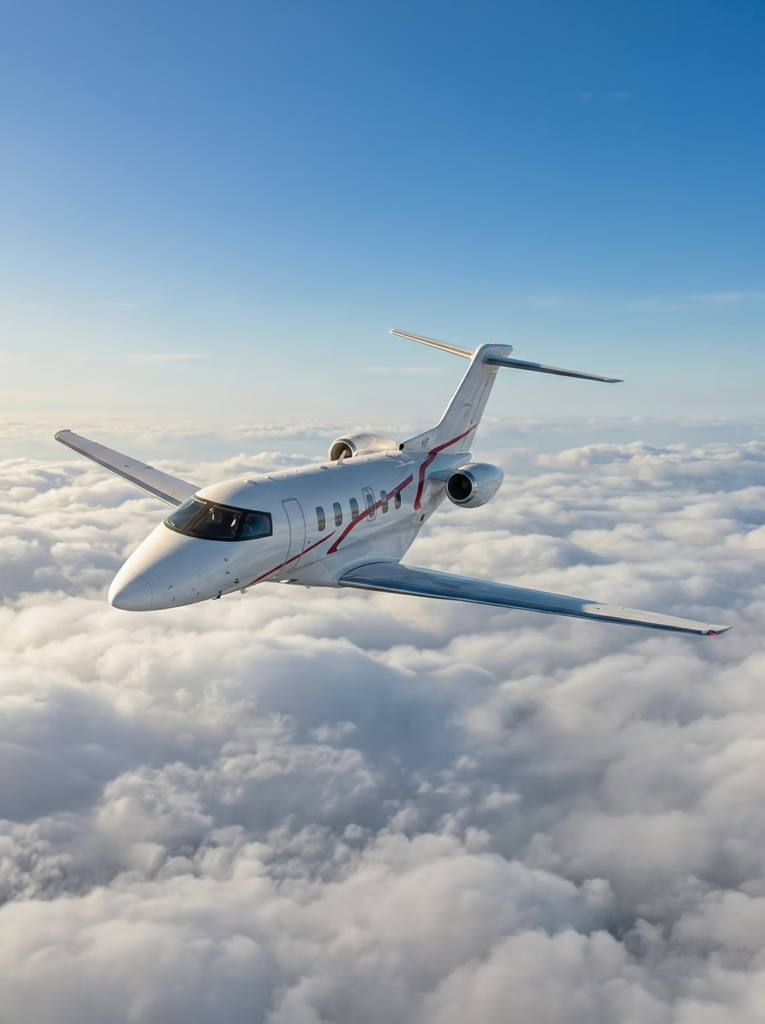
Chartering a private jet in Europe typically costs between €3,000 and €30,000 or more per flight hour, depending on the aircraft category, route, and timing. For a short European hop in a light jet, total trip costs often start around €5,000 to €10,000, while intercontinental missions on heavy jets can reach €100,000 or beyond. The single biggest driver of private jet charter price is the aircraft category you choose. The sections below break down every major cost factor, compare charter formats, and explain how to get the most value from your budget.
What factors determine the price of a private jet charter?
The private jet charter cost is shaped by five core variables: aircraft category, route distance, positioning, timing, and crew and handling fees. No two quotes are identical because each of these factors shifts with every booking. Understanding them gives you a reliable framework for evaluating any quote you receive.
Aircraft category
The single largest cost lever is the type of aircraft. The market is structured around clear categories, and each carries a distinct price band. Turboprops such as the Pilatus PC-12 are the most economical option for short regional hops and access to smaller airfields. Light jets such as the Cessna Citation series seat four to six passengers and suit routes up to roughly two hours. Super-midsize jets such as the Embraer Praetor 600 or Embraer Legacy 500 offer a significantly larger cabin, transatlantic-capable range, and a meaningful step up in comfort. Heavy jets and ultra-long-range aircraft such as the Bombardier Global 5000 or Global 6000 carry up to thirteen or fifteen passengers across intercontinental distances at cruise speeds above 900 km/h, and their hourly operating costs reflect that capability.
Route and positioning
Distance determines flight time, which directly multiplies the hourly rate. But the full route cost includes more than just the sector you fly. If the aircraft is based in a different city, a positioning flight to reach your departure point is typically factored into the quote. A return charter where the aircraft waits at your destination also incurs parking, crew standby, and handling costs. Routes to smaller or more remote airfields may require a specific aircraft type capable of operating on shorter runways, which can narrow your options and affect pricing.
Timing and demand
Peak travel periods, including major events, holiday weekends, and fashion weeks, compress aircraft availability across Europe and push prices upward. Last-minute bookings can work in your favour when empty legs are available, but for peak-date travel, booking early generally produces better pricing and more aircraft options.
Fees beyond the flight hour
Every quote should account for landing fees, ground handling, catering, overnight crew costs, and applicable taxes. These ancillary charges vary significantly by airport and country. A thorough quote consolidates all of them into a single figure so there are no surprises on the invoice.
YOUR NEXT JOURNEY STARTS HERE
Speak with our team about your private aviation needs.
How much does it cost to charter a private jet per hour in 2026?
In 2026, the private jet cost per hour ranges from roughly €1,500 to €2,500 for turboprops, €3,000 to €5,500 for light jets, €5,000 to €9,000 for super-midsize jets, and €8,000 to €18,000 or more for heavy and ultra-long-range jets. These are indicative charter rates for the aircraft time itself and do not include positioning, handling, or taxes.
To put those figures in context, a two-hour flight from Antwerp to Nice in a super-midsize jet such as the Embraer Legacy 500 might carry a total trip cost in the range of €15,000 to €25,000 once all fees are consolidated. A transatlantic mission on a Bombardier Global 6000, with its published range of 11,000 km and cruise speed above 900 km/h, operates in an entirely different price bracket. The aircraft’s home base matters too: an aircraft already positioned near your departure point avoids positioning charges that can add a meaningful percentage to the total.
Hourly rates are a useful comparison tool, but the total trip cost is always the number that matters. A reputable operator will provide a fully itemised quote that reflects the specific route, aircraft, and date rather than a generic rate card. If you want to explore which aircraft categories fit your route and group size, browsing an operator’s fleet is a practical starting point for calibrating expectations.
What is the difference between an empty leg flight and a standard charter?
A standard charter is a flight booked specifically for your itinerary, with an aircraft positioned to your departure point and the route, timing, and aircraft chosen entirely around your needs. An empty leg is a repositioning flight that an operator must fly anyway to move an aircraft back to its base or to its next booking, offered to passengers at a significant discount to offset the cost of flying empty.
Empty legs can represent genuine savings, sometimes 25 to 75 percent below the equivalent standard charter rate. The trade-off is inflexibility. The route, date, and departure time are fixed by the operator’s schedule, not yours. If your plans change, there is typically no flexibility. Empty legs are also announced at short notice and disappear quickly, which means they suit opportunistic travellers rather than those with fixed commitments.
For most high-net-worth travellers, the value of private aviation lies precisely in the ability to depart when and where you choose. A standard charter preserves that control completely. Empty legs are a compelling option when the route happens to align with your plans, but they should be treated as a bonus opportunity rather than a primary booking strategy. Operators such as FLYINGGROUP publish available empty legs alongside their standard private jet charter service, making it straightforward to check whether a discounted positioning flight coincides with your travel needs.
How does chartering compare to owning or fractional ownership?
Chartering a private jet means paying only for the flights you take, with no capital tied up in an asset, no maintenance liability, and no fixed costs between trips. Ownership means acquiring the aircraft outright, accepting full depreciation, maintenance, crew, insurance, and operational costs regardless of how often you fly. Fractional ownership sits between the two: you purchase a share of a specific aircraft type and pay monthly management fees plus occupied hourly rates, gaining priority access but also accepting ongoing fixed costs.
The financial case for chartering strengthens considerably when annual flight hours fall below roughly 200 to 400 hours. Below that threshold, the fixed costs of ownership or fractional programmes typically exceed what the same hours would cost on the charter market. Above that level, ownership economics can shift, though depreciation, management complexity, and the single-aircraft limitation remain real considerations even for frequent flyers.
Beyond the numbers, ownership concentrates your aviation on one aircraft type and one home base. Charter gives you access to the right aircraft for each specific mission: a turboprop for a short hop to a regional airfield, a super-midsize jet for a business day trip to a European capital, and a heavy jet for a transatlantic journey. That flexibility is difficult to replicate through ownership of a single aircraft. For those who fly frequently but value flexibility over asset control, structured programmes such as jet cards or flight hour memberships offer a middle path, combining pre-purchased hours with guaranteed availability and no long-term ownership commitment.
YOUR NEXT JOURNEY STARTS HERE
Speak with our team about your private aviation needs.
Are there ways to reduce the cost of a private jet charter?
Yes. The most effective ways to reduce private jet charter costs are choosing the right aircraft category for the mission, travelling on flexible dates to avoid peak pricing, considering empty leg availability, and exploring pre-purchased hour programmes that offer better rates for committed volume. None of these require compromising on safety or service quality.
- Right-size the aircraft: The most common source of unnecessary cost is booking more aircraft than the mission requires. A group of four flying two hours does not need a heavy jet. A super-midsize or even a light jet delivers the same punctuality and privacy at a fraction of the cost.
- Travel on flexible dates: If your schedule allows even a day’s flexibility around a peak period, the difference in available aircraft and pricing can be material. Avoiding the Friday afternoon and Sunday evening rush across major European routes also tends to produce better quotes.
- Consider empty legs: As outlined above, empty legs offer genuine savings when the route and timing align. They require flexibility, but for leisure travel or non-urgent trips, they are worth monitoring.
- Use a pre-purchased hour programme: For travellers who fly more than 25 hours a year, a jet card or flight hour membership typically delivers better effective rates than booking individual charters each time. FLYINGGROUP’s FlyingCard programme, for example, starts at 25 annual flight hours and combines pre-reserved capacity with the flexibility of on-demand charter.
- Book early for peak dates: Advance booking on high-demand dates secures better aircraft options and, in many cases, better pricing. Last-minute availability during peak periods is limited and commands a premium.
The clearest path to cost efficiency is working with an operator who understands your travel patterns and can advise on the right combination of aircraft, timing, and programme structure for your specific situation. Speaking directly with a charter expert remains the fastest way to get a fully itemised quote built around your actual itinerary rather than a generic rate estimate.