

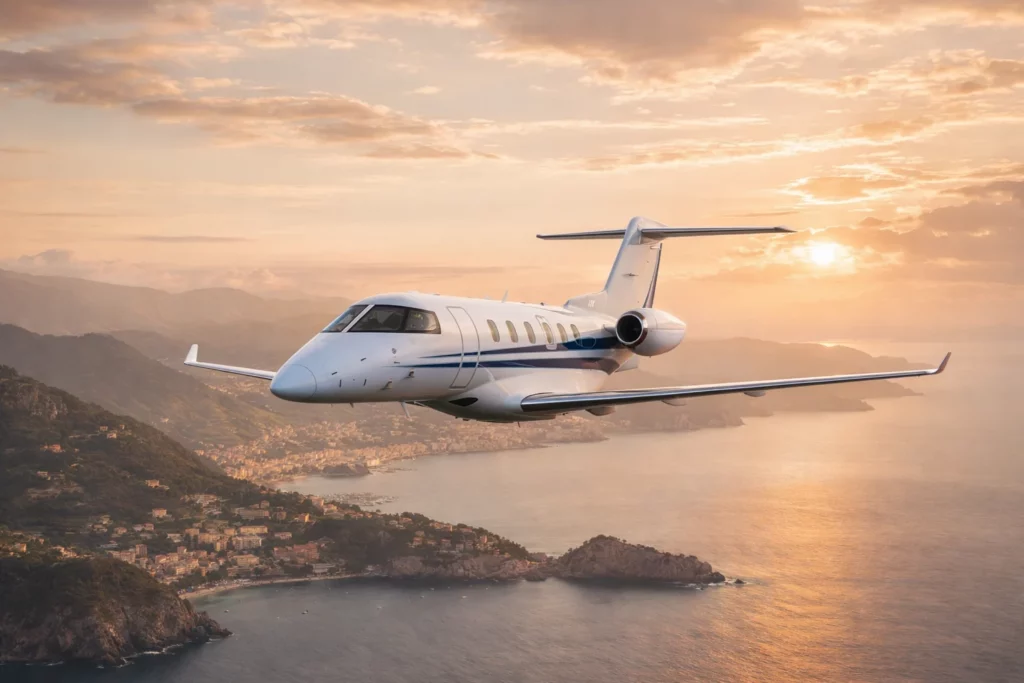
Private jet charter aircraft fall into six main categories: turboprops, very light jets, light jets, midsize jets, super-midsize jets, and heavy jets, with ultra-long-range jets forming a premium tier within the heavy category. The right category depends on the number of passengers, the distance being flown, and the level of cabin comfort required. The sections below address the most common questions clients ask when choosing between aircraft types — explained in plain terms, without assuming any technical aviation knowledge.
How are private charter aircraft grouped into categories?
Private charter aircraft are grouped into categories based on cabin size, range, and passenger capacity. The main categories are turboprops, very light jets (VLJs), light jets, midsize jets, super-midsize jets, and heavy jets. Ultra-long-range jets are a specialist tier within the heavy category, designed for intercontinental routes without a fuel stop.
Each category reflects a distinct combination of characteristics that affect your journey in practical ways. Turboprops use propeller-driven engines — think of them as the most agile option in the private aviation world — and excel on short hops into smaller airfields that jets cannot reach. A well-known example is the Pilatus PC-12, a single-engine turboprop that combines impressive range with the ability to land on short, unpaved strips. Very light jets and light jets seat between four and seven passengers and are optimized for regional flights under three hours. A popular example in this category is the Embraer Phenom 300, one of the most widely flown light jets in Europe. Midsize jets offer more cabin height and range, making them the workhorse of European and transatlantic business travel — the Cessna Citation XLS+ is a representative example. Super-midsize jets bridge the gap between midsize and heavy, offering stand-up cabins and ranges of roughly 4,000 to 5,000 nautical miles; the Bombardier Challenger 350 sits firmly in this segment. Heavy jets provide full stand-up cabins, dedicated sleeping areas, and the range to connect continents, with aircraft like the Gulfstream G550 setting the benchmark.
Understanding which category fits a journey is the first step toward selecting the right aircraft. Operators like FLYINGGROUP maintain fleets that span multiple categories, and their charter experts can match a specific aircraft to any combination of route, group size, and budget. You can explore the available charter fleet options to get a sense of what each category looks like in practice.
YOUR NEXT JOURNEY STARTS HERE
Speak with our team about your private aviation needs.
What is the difference between a light jet and a midsize jet?
The core difference between a light jet and a midsize jet is cabin size and range. Light jets typically seat four to seven passengers in a compact cabin with limited headroom — most passengers cannot stand upright — and have a range of roughly 1,500 to 2,000 nautical miles (approximately 2,800 to 3,700 kilometres). Midsize jets seat six to nine passengers in a taller, wider cabin and can fly 2,500 to 3,500 nautical miles without a stop.
In practical terms, a light jet such as the Embraer Phenom 300 is well suited to shorter European legs — London to Geneva, Brussels to Malaga, or Paris to Milan — where speed and cost efficiency matter more than space. Passengers on these flights typically sit in club-style seating (two pairs of seats facing each other) and have access to a small galley and lavatory. Luggage capacity is more limited, which can matter for longer leisure trips.
A midsize jet changes the experience meaningfully. The stand-up or near-stand-up cabin allows passengers to move around freely during the flight, and the additional range makes it viable for routes such as London to Dubai or Amsterdam to New York with a single fuel stop. A good example is the Cessna Citation XLS+, which offers a comfortable eight-seat cabin with a proper work area. The galley and lavatory are more generously sized, and many midsize jets feature flat-fold seats that allow passengers to rest on longer sectors. For frequent business travelers who prioritize productivity in the air, the step up to midsize often justifies the difference in charter price.
When should you charter a heavy or ultra-long-range jet?
A heavy jet is the right choice when the flight requires a large passenger group, a fully equipped cabin for sleeping or extended work, or a non-stop range beyond 4,000 nautical miles (roughly 7,400 kilometres). Ultra-long-range jets extend that capability further, connecting Europe with the US East Coast, the Gulf, or Asia without a fuel stop — eliminating the time and disruption of an intermediate landing — making them the standard for intercontinental private travel.
Heavy jets typically seat eight to fourteen passengers and feature full stand-up cabins, dedicated sleeping quarters, a proper galley, and separate lavatory facilities. A well-known example is the Bombardier Global 6000, which offers a three-zone cabin where passengers can work, dine, and sleep in separate areas. These aircraft are built for journeys where the cabin is as important as the destination — where a board meeting, a full night’s sleep, or a family dinner at altitude is part of the itinerary.
Ultra-long-range jets push range beyond 7,000 nautical miles in many cases. The Gulfstream G700, for example, can fly non-stop from London to Singapore, saving the several hours that a fuel stop would otherwise add. For clients traveling between Europe and North America, the Middle East, or Asia, this category eliminates the time cost and disruption of a fuel stop. The cabin appointments on these aircraft are often comparable to a premium business-class suite, with lie-flat beds, entertainment systems, and private staterooms on the largest configurations.
The decision to charter at this level is rarely about range alone. It is about arriving rested, maintaining confidentiality throughout a long journey, and having a controlled environment for sensitive conversations or family travel across time zones.
What aircraft types can access smaller or remote airfields?
Turboprops and light jets are the aircraft types best suited to smaller and remote airfields. These aircraft have shorter takeoff and landing requirements — meaning they need less runway to get airborne and to stop safely — allowing them to operate from airstrips that are too short or too narrow for midsize and heavy jets. This flexibility opens up destinations that commercial aviation and larger private jets simply cannot reach.
Turboprops are particularly effective in this role. The Pilatus PC-12, for instance, can operate from grass strips as short as 600 metres, making it the aircraft of choice for remote destinations across Europe and beyond. Its lower approach speeds and robust undercarriage make it well suited to unpaved or grass strips, mountain airstrips, and island runways with limited infrastructure. For destinations in the Scottish Highlands, the Greek islands, Alpine valleys, or remote business parks with private strips, a turboprop is often the only viable aircraft choice. Rather than driving two hours from the nearest commercial airport, you land close to where you actually need to be — saving time and arriving on your own schedule.
Light jets can also access many regional and secondary airports that fall outside the commercial network. Flying into a smaller airport close to the actual destination, rather than a major hub an hour’s drive away, is one of the most tangible time advantages of private aviation. A flight that lands twenty minutes from a meeting or a villa eliminates the ground transfer that often accounts for more travel time than the flight itself. The Embraer Phenom 100 is a good example of a very light jet that combines this airfield flexibility with a comfortable, modern cabin.
FLYINGGROUP’s fleet is specifically designed with this flexibility in mind, combining aircraft types that can serve both major European hubs and the more remote airfields that clients often need for leisure or regional business travel.
Which aircraft type is best for a group of 8–12 passengers?
For a group of 8 to 12 passengers, a heavy jet or a super-midsize jet is typically the most appropriate aircraft type. Heavy jets comfortably seat 8 to 14 passengers depending on configuration, while super-midsize jets can accommodate 8 to 10 in a more compact but still spacious cabin. The right choice depends on the route length and how much cabin comfort the group requires.
For shorter European routes with a group of this size, a super-midsize jet such as the Bombardier Challenger 350 offers an excellent balance of space and cost. The cabin is wide enough for everyone to sit comfortably, and the range covers most intra-European and short transatlantic sectors without difficulty. Compared to splitting a group across two smaller aircraft — which adds coordination complexity and often costs more — a single super-midsize jet is a straightforward, efficient solution.
For longer routes, or where the group includes families with children, executives who need workspace, or passengers who want to sleep, a heavy jet such as the Bombardier Global 6000 or the Dassault Falcon 7X is the more practical solution. The additional cabin length and height make a significant difference over a four- or five-hour flight. Some heavy jet configurations include a forward cabin and an aft lounge, effectively giving a large group two separate social spaces — useful when some passengers want to work quietly while others relax.
It is also worth considering whether the group’s luggage requirements influence the choice. Twelve passengers traveling for a week’s holiday generate considerably more baggage than the same group flying to a one-day meeting, and cargo capacity varies meaningfully between aircraft categories. A charter specialist can factor this into the aircraft recommendation from the outset. For groups with specific requirements, FLYINGGROUP’s charter service covers fleet options across all relevant categories.
YOUR NEXT JOURNEY STARTS HERE
Speak with our team about your private aviation needs.
How does aircraft type affect charter price?
Aircraft type is the single largest driver of private jet charter price. As a general rule, charter costs increase with cabin size, range capability, and aircraft age. A turboprop or light jet charter costs significantly less per hour than a midsize jet, which in turn costs less than a heavy or ultra-long-range aircraft. The difference between a light jet and a heavy jet on the same route can be substantial — often two to three times the hourly rate.
Several factors tied to aircraft type influence the final price:
- Hourly operating cost: Larger, more powerful aircraft burn more fuel and carry higher crew and maintenance costs, which are reflected in the charter rate.
- Positioning fees: If the aircraft needs to reposition from its base to the departure airport, that empty leg — the flight with no passengers on board — is often charged to the client. Operators with larger fleets and multiple bases can minimize this cost by sourcing an aircraft already close to the departure point.
- Landing and handling fees: Larger aircraft attract higher airport fees at most European and international airports, adding to the total trip cost.
- Overnight and crew costs: For multi-day trips, the aircraft category affects crew accommodation requirements and any applicable overnight charges.
Choosing the right aircraft type for a specific mission — rather than defaulting to the largest or the smallest available — is one of the most effective ways to manage charter costs without compromising the travel experience. There is little value in chartering a heavy jet for a two-hour hop between European cities when a light jet covers the same route comfortably and at a fraction of the cost. A charter expert will assess the route, the group size, the luggage requirements, and the desired comfort level before recommending an aircraft that fits both the mission and the budget. For a tailored quote based on your specific itinerary, contact the FLYINGGROUP team directly.
Related Articles
- How does a private jet charter company match aircraft to your trip?
- What types of aircraft are available for private jet charter?
- How do you book a private jet charter flight?
- What is the difference between owning and chartering a private jet?
- What is the difference between private jet charter and ownership?