

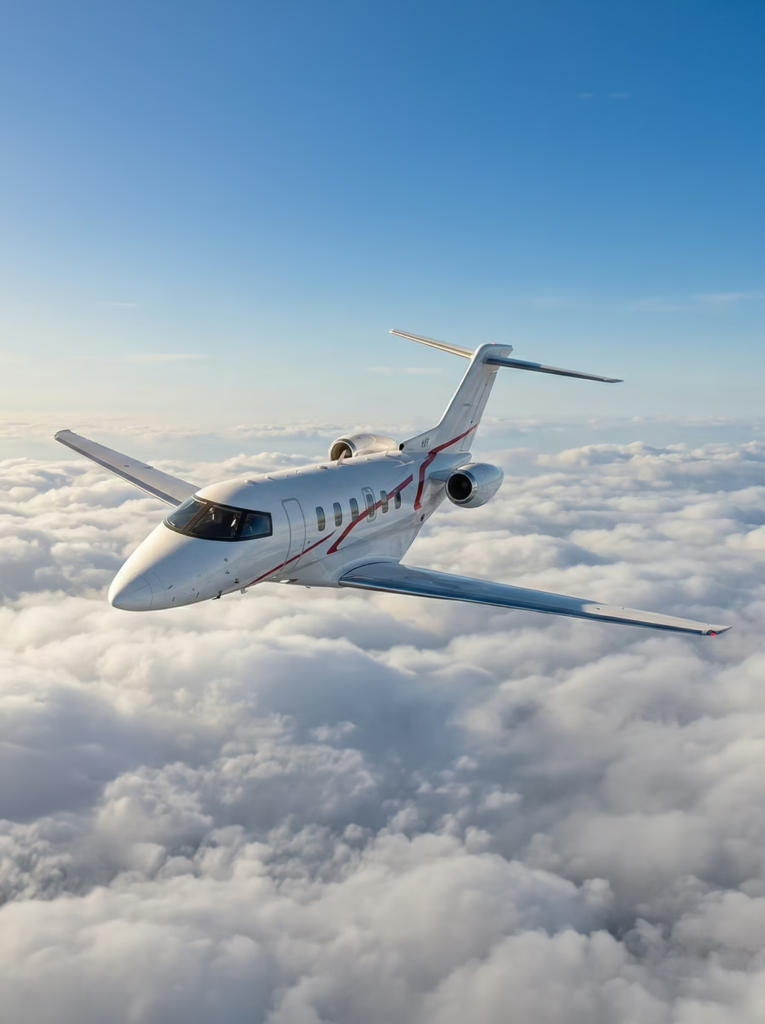
Private jet charter is a service that lets you book an entire aircraft for your exclusive use, flying on your schedule to your chosen destination. Unlike commercial aviation, there are no shared cabins, fixed departure times, or crowded terminals: you decide when and where you fly. The sections below answer the most common questions about how private jet charter works, what it costs, which aircraft are available, and how it compares to other private aviation options.
How does booking a private jet charter actually work?
Booking a private jet charter works by contacting an operator or charter broker, specifying your route, travel dates, passenger numbers, and any preferences, then receiving a tailored quote for a dedicated aircraft. Once you confirm and pay, the operator handles all flight planning, permits, and ground arrangements. The entire process can move quickly: even same-day departures are possible with the right operator.
The first step is a conversation rather than a form. You share your origin, destination, travel date, number of passengers, and any baggage or special requirements. A charter specialist then matches your mission to a suitable aircraft from the available fleet or from a network of vetted partner operators. The quote you receive should confirm the aircraft model and configuration, the number of usable seats, baggage capacity, the operating base, the executing operator, and airport acceptance. These are the details that matter when comparing options.
Once you approve the proposal, confirmation follows quickly. The operator files the flight plan, secures any necessary permits or slots, and coordinates ground handling at both ends. On the day of travel, you arrive at the private terminal, often called an FBO, drive directly to the aircraft, and board without queues or security theatre. For operators like FLYINGGROUP, booking a charter flight can be as straightforward as sending a WhatsApp message, reflecting how personal and accessible the process is designed to be.
YOUR NEXT JOURNEY STARTS HERE
Speak with our team about your private aviation needs.
What’s included in a private jet charter flight?
A private jet charter flight typically includes exclusive use of the aircraft, a professional crew, fuel, standard catering, ground handling at departure and arrival, and all standard operational fees. What counts as standard varies by operator, so always confirm what is and is not included in the quoted price before you confirm.
At the core, you are paying for the aircraft and its crew for your flight. Beyond that, most reputable operators include:
- Professional pilots licensed for the specific aircraft type
- Standard in-flight catering and beverages, often customizable on request
- Ground handling at both departure and arrival airports
- Flight planning, weather briefings, and operational coordination
- Use of private terminal facilities at departure
Premium operators extend the experience beyond the aircraft itself. FLYINGGROUP, for example, offers an in-house FBO with personalized security screening and seamless transportation arrangements, and can organize connecting limousine or helicopter transfers to complete the journey. This door-to-door thinking is what separates a genuinely curated private flight from simply renting a seat in a smaller cabin.
One important operational note: a slot or PPR (prior permission required) at an airport does not automatically guarantee parking for your aircraft, particularly at busy destinations. Parking duration, overnight stays, and any positioning flights that bring the aircraft to your departure point can all affect the final cost and logistics, details your operator should confirm explicitly at the quoting stage.
How much does it cost to charter a private jet?
The cost to charter a private jet varies widely depending on the aircraft category, route distance, flight duration, and timing. A short European hop in a light jet typically starts from a few thousand euros, while a transatlantic flight in a large-cabin jet can reach five figures or more. There is no single price: every charter is priced for the specific mission.
Several factors drive the final figure:
- Aircraft category: Larger, longer-range aircraft cost more per hour to operate and therefore more to charter.
- Route and distance: Longer flights require more fuel and crew time. Short hops can still carry minimum flight charges.
- Positioning costs: If the aircraft needs to fly empty from its base to your departure airport, that positioning leg may be reflected in the price, or offered as an empty leg at a discount to another traveller.
- Timing and availability: Last-minute bookings, peak travel periods, and high-demand destinations can affect pricing.
- Additional services: Upgraded catering, specific ground transport, and extended overnight parking add to the base cost.
The most transparent way to understand the true cost is to request a detailed quote that separates the flight fee from extras. Comparing quotes also means comparing like for like: the aircraft model, actual bookable seats, and included services should all be specified clearly.
What types of aircraft are available for charter?
Charter aircraft are broadly grouped into turboprops, light jets, super light jets, midsize jets, super midsize jets, and heavy jets. Each category suits different route lengths, passenger numbers, and airfield types. The right choice depends on where you are going, how many people are travelling, and how much baggage you need to carry.
Turboprops
Turboprops are propeller-driven aircraft powered by jet engines and are well suited to shorter routes and smaller or more challenging airfields. The Pilatus PC-12 is a strong example, a versatile single-engine turboprop capable of landing on shorter runways that jets cannot use, making it ideal for reaching remote or mountain destinations. Turboprops are typically more economical on shorter legs and can access airstrips that open up destinations unavailable to larger aircraft.
Light and super light jets
Light jets such as the Cessna Citation series comfortably seat four to six passengers and cover routes up to around two to three hours. They are efficient, fast to board, and well suited to European city pairs. Super light jets offer a step up in range and cabin space while remaining economical for regional travel.
Midsize and super midsize jets
Midsize jets, including aircraft like the Embraer Praetor 600, bridge the gap between short-range efficiency and intercontinental capability. They typically seat seven to nine passengers with stand-up cabin height and meaningful baggage capacity. Super midsize jets extend the range further, connecting Europe with destinations in the Middle East or North Africa non-stop.
Heavy jets
Heavy jets such as the Dassault Falcon 900 series offer large cabin volumes, full stand-up headroom, separate seating zones, and the range to cross oceans. They suit groups of eight or more, long-haul itineraries, or travellers who prioritize space and on-board productivity above all else. It is worth noting that maximum seat capacity, published range, and baggage capacity are separate specifications: a heavy jet flying at full passenger load with substantial luggage may not achieve its maximum published range.
You can explore the aircraft available across these categories on the FLYINGGROUP fleet page, which spans models from multiple manufacturers to cover a wide range of missions and budgets.
YOUR NEXT JOURNEY STARTS HERE
Speak with our team about your private aviation needs.
What’s the difference between charter, jet cards, and shared ownership?
Charter, jet cards, and shared ownership are three distinct ways to access private aviation, each suited to different flying frequencies and financial preferences. Charter requires no upfront commitment, jet cards pre-purchase a block of hours for regular flyers, and shared ownership involves co-owning a specific aircraft with other parties. The right option depends on how often you fly and how much operational involvement you want.
On-demand charter
On-demand charter is the most flexible option. You book a flight when you need one, with no ongoing commitment, no annual fees, and no responsibility for the aircraft between flights. It suits travellers who fly privately a handful of times per year or whose schedules are unpredictable. The trade-off is that pricing reflects market conditions at the time of booking.
Jet cards and membership programmes
Jet card programmes, such as FLYINGGROUP’s FlyingCard, allow you to pre-purchase a set number of flight hours, starting at 25 hours per year, at agreed rates. This approach combines the flexibility of charter with more predictable pricing and priority access. It suits frequent flyers who want consistency without the full financial and operational commitment of owning an aircraft.
Shared ownership
Shared ownership means co-owning a specific aircraft with a limited number of other parties, giving each owner a guaranteed share of flight hours. It offers greater control over the aircraft and can be cost-effective for those who fly frequently enough to justify it. However, it comes with capital exposure, depreciation, and a degree of scheduling coordination with co-owners, considerations that lead many high-net-worth travellers to prefer structured charter programmes instead.
For those evaluating these options, the full range of FLYINGGROUP services, including FlyingCard, FlyingMember, and FlyingPartners, reflects how private aviation access can be structured to match different travel patterns without requiring aircraft ownership.
Which airports can a chartered private jet use?
A chartered private jet can use a far wider range of airports than commercial airlines, including smaller regional airfields, mountain airstrips, and private terminals at major hubs. The specific airports accessible depend on the aircraft type, its performance capabilities, and the operational approvals held by the executing operator. This flexibility is one of the defining advantages of private jet charter.
Commercial airlines are largely confined to major international airports with long runways and high-volume infrastructure. Private jets, particularly turboprops and light jets, can operate from much shorter runways, putting destinations within reach that would otherwise require a long drive from the nearest commercial hub. A business meeting in a regional city, a ski chalet in the Alps, or a coastal resort accessible only via a small airfield all become straightforward propositions.
That said, not every aircraft suits every airfield. Specialist destinations such as mountain altiports impose strict aircraft type restrictions, and some airports have noise curfews, night operation limitations, or slot requirements that affect scheduling. At Paris Le Bourget, for instance, jet departures are restricted during certain overnight hours under current regulations, a detail that affects late-night or early-morning departures and must be factored into planning.
A slot or PPR (prior permission required) at a given airport also does not automatically guarantee parking for your aircraft. Parking availability, overnight stays, and whether the aircraft must reposition to another location between legs are all separate questions that a thorough operator will address at the quoting stage.
The practical takeaway is that your charter operator’s fleet composition and network matter considerably. An operator with a diverse fleet, spanning turboprops through to heavy jets, and strong relationships at airports across Europe can reach destinations that a narrower operator simply cannot. To discuss a specific route or destination, getting in touch with a charter specialist directly is the most reliable way to confirm what is operationally possible for your exact itinerary.