

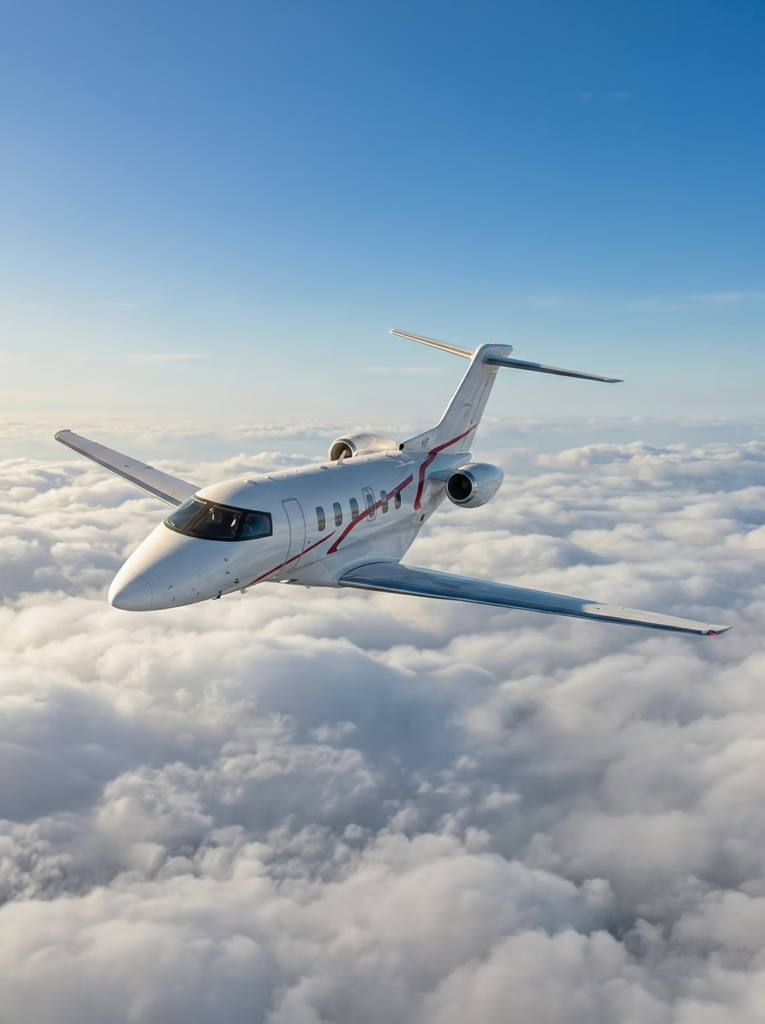
Private jet charter aircraft fall into five main categories: turboprops, light jets, midsize jets, super-midsize jets, and heavy jets. The right category depends on how many passengers you are flying, how far you need to travel, and what level of cabin comfort you require. The sections below answer the most common questions about each type so you can make a confident, informed choice.
How are private charter aircraft typically categorized?
Charter aircraft are grouped into five categories based on cabin size, passenger capacity, and range: turboprops, light jets, midsize jets, super-midsize jets, and heavy jets. Each category represents a meaningful step up in space, speed, and operating range, giving operators and clients a practical framework for matching the right aircraft to a specific trip.
The categories are not arbitrary marketing labels. They reflect genuine differences in airframe design, engine power, and certified performance. A light jet and a heavy jet are built for fundamentally different missions, and understanding the distinctions helps you avoid paying for capability you do not need or booking an aircraft that falls short of your requirements.
Within each category, individual models vary in interior configuration, baggage volume, and onboard amenities. Published specifications such as maximum range and passenger count are useful starting points, but the combination of full passenger load, luggage weight, and route conditions can affect real-world performance. Always confirm the details with your charter operator before booking.
YOUR NEXT JOURNEY STARTS HERE
Speak with our team about your private aviation needs.
What are the differences between light, midsize, and heavy jets?
Light jets seat four to seven passengers and are optimized for shorter European routes of up to roughly 3,000 kilometers, offering a fast and cost-efficient solution for small groups. Midsize jets add cabin stand-up height, more baggage space, and a range that comfortably covers most of Europe. Heavy jets carry eight to fourteen passengers in a full stand-up cabin with sleeping areas and can fly transatlantic or intercontinental routes non-stop.
Light jets
Light jets such as the Cessna Citation CJ3+ are the workhorses of short-haul private aviation. Their compact size allows access to smaller regional airfields that larger aircraft cannot use, which is a genuine advantage when your destination sits close to a city center rather than a major international hub. Cabin comfort is real but modest: seats are well-appointed, but standing headroom is limited and baggage space is tighter than on larger categories.
Midsize jets
Midsize jets bridge the gap between efficiency and comfort. A cabin you can stand up in, seating for six to eight passengers, and a range that stretches from Antwerp to Moscow or Lisbon without a fuel stop make this category the most versatile choice for European business travel. The Cessna Citation Sovereign is a representative example: capable, comfortable, and genuinely flexible across a wide range of European routes.
Heavy jets
Heavy jets such as the Bombardier Global 5000 or Global 6000 are designed for groups that need space, range, and full productivity in the air. A dedicated lounge area, flat-bed sleeping positions, and a separate galley turn a long flight into a productive or restful environment. These aircraft are the natural choice for intercontinental travel or for larger delegations where the cabin itself is part of the experience.
When should you choose a turboprop over a private jet?
A turboprop is the better choice when your destination has a short or unpaved runway that jets cannot use, when your group is small, or when the flight is short enough that the jet’s speed advantage does not meaningfully reduce total travel time. Turboprops are also a practical option for mountainous or island destinations where airfield access is the primary constraint.
The Pilatus PC-24 is a compelling example of how the turboprop category has evolved. Technically a jet-powered aircraft, the PC-24 is engineered with the short-field performance of a turboprop, allowing it to operate from grass strips and short runways that standard business jets cannot reach. FLYINGGROUP includes the PC-24 in its charter fleet, and the aircraft has been confirmed for operations into demanding airfields that other jets in its class cannot serve.
For trips under 500 kilometers, the speed difference between a turboprop and a light jet is often less than thirty minutes in the air. When you factor in the ability to depart from a closer, less congested airfield, a turboprop can actually reduce your total door-to-door travel time compared with a jet operating from a major hub.
Which aircraft type is best for long-haul private charter?
For long-haul private charter, heavy jets and ultra-long-range jets are the appropriate categories. Aircraft such as the Bombardier Global 6000, Dassault Falcon 7X, or Dassault Falcon 900LX offer the range to fly from Europe to North America, the Middle East, or Asia without a technical stop, combined with a cabin large enough to work, dine, and sleep comfortably during an extended flight.
Range on paper and range in practice are not always the same figure. A fully loaded aircraft flying into a headwind will not achieve its published maximum range. This is why the rule that maximum seats, published range, and full baggage capacity cannot all be guaranteed simultaneously is worth taking seriously. When planning a transatlantic or intercontinental itinerary, confirm the specific routing, passenger count, and luggage weight with your operator before committing to a non-stop flight.
Super-midsize jets such as the Embraer Praetor 600 occupy an interesting middle ground for long-haul travel. With a published range of around 7,000 kilometers and a cabin that seats up to eight passengers, this category can handle many transatlantic city pairs while remaining more cost-efficient than a full heavy jet. For groups of four to six passengers flying between Europe and the eastern United States, a super-midsize jet often delivers the best balance of range, comfort, and operating cost.
Does the aircraft type affect charter pricing?
Yes, aircraft type is one of the primary drivers of charter pricing. Larger, longer-range aircraft cost more to operate per hour, and those costs are reflected in the charter rate. As a general principle, moving up one category (from light to midsize, or from midsize to heavy) typically increases the hourly rate meaningfully, though the exact difference depends on the specific model, the route, and market conditions at the time of booking.
Several factors interact with aircraft type to shape the final price:
- Positioning flights: If the aircraft needs to fly empty to your departure airport, that repositioning cost is often passed on to the client. Choosing an aircraft based at or near your departure point can reduce this significantly.
- Route length: On short routes, a light jet and a midsize jet may differ by less in total cost than their hourly rates suggest, because the flight time is brief. On longer routes, the hourly difference compounds.
- Empty leg availability: Discounted empty leg flights are category-specific. If a heavy jet is available on an empty leg that matches your route, it can offer exceptional value relative to its standard charter rate.
- Seasonal demand: Pricing for popular categories on high-demand routes (such as heavy jets to the south of France in summer) reflects market pressure, not just operating cost.
The most cost-efficient approach is to match the aircraft category precisely to your actual requirements rather than defaulting to the largest available option. A charter specialist can help you identify where a smaller category delivers everything you need at a lower price point.
YOUR NEXT JOURNEY STARTS HERE
Speak with our team about your private aviation needs.
Can you request a specific aircraft model when booking a charter?
Yes, you can request a specific aircraft model when booking a charter, and a reputable operator will do their best to accommodate that preference. However, availability of a named model on a specific date cannot always be guaranteed, and operators may propose an equivalent alternative from the same category if the requested aircraft is already committed to another flight.
When a particular model matters (because of cabin configuration, baggage capacity, or airfield performance requirements), communicate that clearly when requesting a quote. Ask the operator to confirm the specific model, its current base, the number of bookable seats, and the baggage volume for your itinerary. These details can vary even between two aircraft of the same type, depending on how each has been configured by its owner or operator.
For clients who fly frequently and have strong preferences about the aircraft they use, a structured program such as a jet card or membership can offer more consistent access to preferred types. FLYINGGROUP’s charter service spans a range of categories and models, and the team can advise on which aircraft best fits your route, group size, and comfort expectations, whether you are booking a single flight or planning a longer travel program. You can contact the team directly to discuss your requirements and receive a tailored recommendation.