

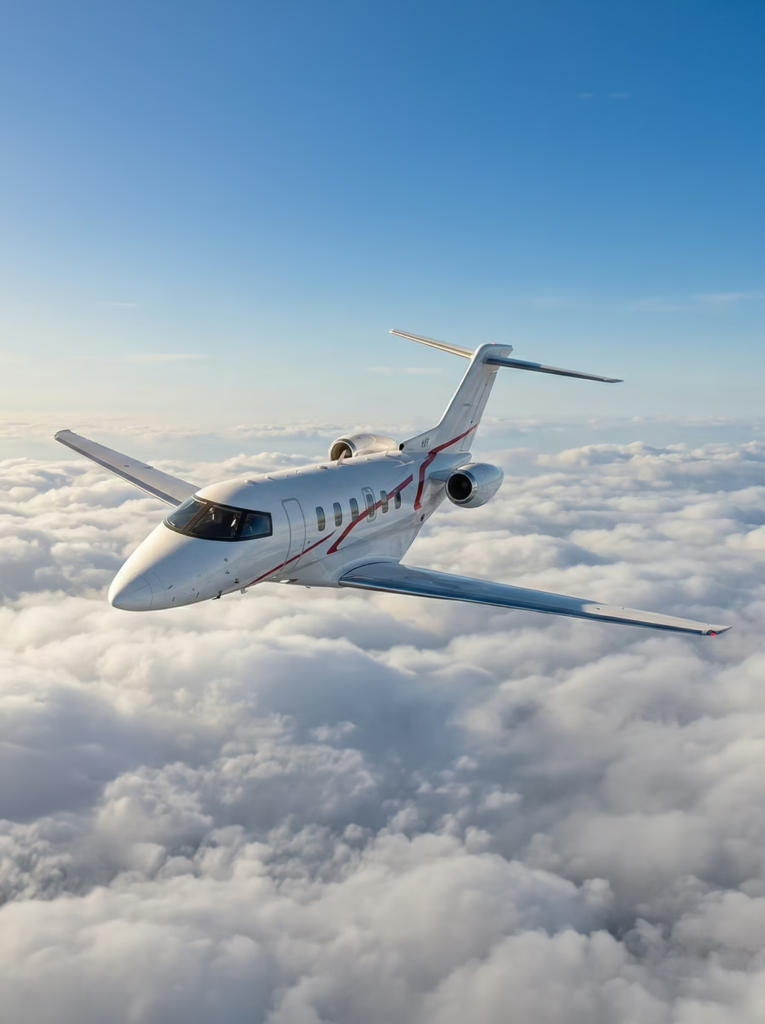
A light jet and a long-range jet are fundamentally different tools for different missions. A light jet typically carries four to seven passengers up to around 3,000 kilometres, making it ideal for shorter European routes. A long-range jet carries up to fourteen passengers across distances of 8,000 kilometres or more, connecting continents non-stop in a spacious, full-service cabin. The right choice depends almost entirely on where you are going, how many people are travelling, and how much comfort you need in the air. The sections below break down the key differences across range, cabin, cost, and use case, so you can match the right aircraft category to your specific trip.
How far can a light jet fly compared to a long-range jet?
A light jet typically has a range of roughly 2,500 to 3,500 kilometres, while a long-range jet can cover 8,000 to 11,000 kilometres or more without stopping. In practical terms, a light jet handles routes like London to Rome or Amsterdam to Marrakech with ease, but it cannot cross the Atlantic or reach the Middle East non-stop. A long-range jet eliminates those boundaries entirely.
To put this in concrete terms: a Cessna Citation CJ3, a well-known light jet, comfortably connects two European cities in a couple of hours. A Dassault Falcon 7X, a flagship long-range aircraft with a published range of around 11,000 kilometres and a cruise speed of approximately 1,030 km/h, can fly from Amsterdam to destinations in North America, the Gulf, or East Asia without a fuel stop. The Bombardier Global 6000 sits in the same ultra-long-range category, with a published range of around 11,000 kilometres as well.
It is worth remembering that published range figures assume specific conditions: a set number of passengers, cruise altitude, fuel reserves, and wind. Real-world range varies with payload, routing, and weather. A long-range jet carrying a full cabin of fourteen passengers with heavy luggage will not achieve the same distance as the same aircraft with six passengers and minimal bags.
YOUR NEXT JOURNEY STARTS HERE
Speak with our team about your private aviation needs.
What are the main cabin differences between light jets and long-range jets?
The cabin of a light jet is compact and efficient, typically seating four to seven passengers in a single-zone layout with limited standing height and modest luggage space. A long-range jet offers a fundamentally different environment: a wide, multi-zone cabin with full standing room, dedicated seating and sleeping areas, a private lavatory, and generous baggage capacity. For flights over three hours, this difference becomes significant.
In a light jet such as an Embraer Phenom 300, the focus is on getting you there quickly and comfortably for shorter hops. Seats are well-appointed, and the experience is far superior to any commercial alternative on the same route, but the space is purposefully sized for efficiency rather than extended comfort.
Step aboard a Dassault Falcon 900LX, a heavy long-range jet with a three-engine design and a published range of around 8,200 kilometres, and the experience shifts entirely. The cabin accommodates up to fourteen passengers across multiple zones, with enough room to hold a working meeting in one area while other passengers rest in another. Baggage capacity runs to approximately 3.6 cubic metres, and the lavatory is a proper private facility rather than a compact space. On intercontinental routes where you might spend eight to twelve hours in the air, these details matter enormously.
Which is more cost-effective, a light jet or a long-range jet?
A light jet is significantly less expensive to charter than a long-range jet. For short European routes with a small group, a light jet delivers the best value: lower hourly rates, lower fuel burn, and lower handling costs. A long-range jet costs more per hour to operate, but when you divide that cost across a larger group or factor in the elimination of a fuel stop, the per-seat economics can shift considerably.
The cost comparison depends on three variables: distance, group size, and time value. For a two-hour flight between two European cities with three passengers, a light jet is almost always the smarter financial choice. For a transatlantic flight with ten passengers, a long-range jet may actually be more cost-efficient per seat than routing everyone through a connecting hub or chartering multiple smaller aircraft.
There is also the indirect cost of a fuel stop to consider. Adding a technical stop to a long journey extends total travel time, introduces additional ground handling fees, and creates an additional operational variable. A long-range jet that can fly the mission non-stop eliminates all of that, and for high-net-worth travellers whose time is their most valuable asset, the premium for a direct flight frequently justifies itself.
What types of trips is a light jet best suited for?
A light jet is best suited for short to medium-haul European routes with small groups of two to six passengers. Think same-day business trips between major cities, weekend leisure flights to coastal or mountain destinations, or time-sensitive point-to-point movements where speed and simplicity matter more than cabin size.
Typical use cases include a morning flight from Brussels to Zurich for a board meeting and a return the same evening, a leisure trip from London to Málaga for a long weekend at a Costa del Sol villa, or a quick transfer to a ski destination such as Salzburg during the winter season. On these routes, a light jet delivers everything the mission requires: speed, privacy, flexibility, and direct access to smaller airfields that commercial airlines simply do not serve.
That last point is particularly relevant. Light jets can operate into shorter runways and more constrained airfields that are inaccessible to larger aircraft. This opens up destinations far closer to the final destination, saving significant ground transfer time. A light jet landing at a regional airfield ten minutes from a client’s villa is a very different proposition from a commercial flight into a major hub followed by a two-hour drive.
YOUR NEXT JOURNEY STARTS HERE
Speak with our team about your private aviation needs.
When does it make sense to charter a long-range jet?
Chartering a long-range jet makes sense when your route exceeds roughly 4,000 to 5,000 kilometres, when you are travelling with a larger group of eight or more passengers, or when the nature of the trip demands a premium cabin environment, for extended rest, confidential business discussions, or simply the highest standard of airborne comfort available.
Intercontinental routes are the clearest case: flying from Europe to the United States, the Middle East, or Asia non-stop requires a long-range aircraft by definition. But long-range jets are also the right choice for shorter routes when the group is large enough to fill the cabin, making the per-seat cost competitive, or when the client’s expectations for onboard experience set the standard.
Multi-stop itineraries across several time zones are another strong use case. A long-range jet with a capable crew can handle complex routing (multiple countries in a single day, overnight positioning, or back-to-back legs across continents) in a way that smaller aircraft simply cannot sustain. Private jet charter specialists can match the right long-range aircraft to these demanding itineraries, ensuring that range, cabin configuration, and crew rest requirements all align with the mission.
Are there jet categories between light and long-range?
Yes. The private jet market spans several distinct categories between a light jet and a long-range jet. The most important intermediate categories are the super light jet, the midsize jet, and the super midsize jet, each offering progressively more range, cabin space, and passenger capacity than the one before it.
- Super light jet: A step up from a standard light jet, offering slightly more cabin space and range, typically up to around 4,000 kilometres, while remaining efficient for shorter European routes. The Embraer Phenom 300 is a well-regarded example in this category.
- Midsize jet: Seats six to eight passengers with full stand-up cabin height on many models and a range extending to roughly 5,000 to 6,000 kilometres. The Cessna Citation XLS is a classic midsize reference point.
- Super midsize jet: Bridges the gap between midsize and heavy, with transatlantic-capable range on some models and a cabin that approaches the comfort level of a large-cabin aircraft. The Embraer Praetor 600, which FLYINGGROUP offers with nine passenger seats and a published range of around 7,441 kilometres under optimal conditions, sits in this category.
- Heavy jet / large-cabin jet: Offers a full stand-up cabin, separate zones, and ranges from roughly 6,000 to 8,500 kilometres. The Dassault Falcon 2000LX, with ten seats and a published range of 6,600 kilometres, is a strong example of a heavy jet with intercontinental reach.
Understanding these intermediate categories matters because the right aircraft is rarely at either extreme. Many missions fall squarely in the midsize or super midsize range: long enough to need more than a light jet, but not so demanding that a full long-range aircraft is necessary. Exploring the full charter fleet gives a clear picture of which aircraft categories are available for any given route, and an experienced charter team can advise on the most efficient match between the aircraft and the mission.