

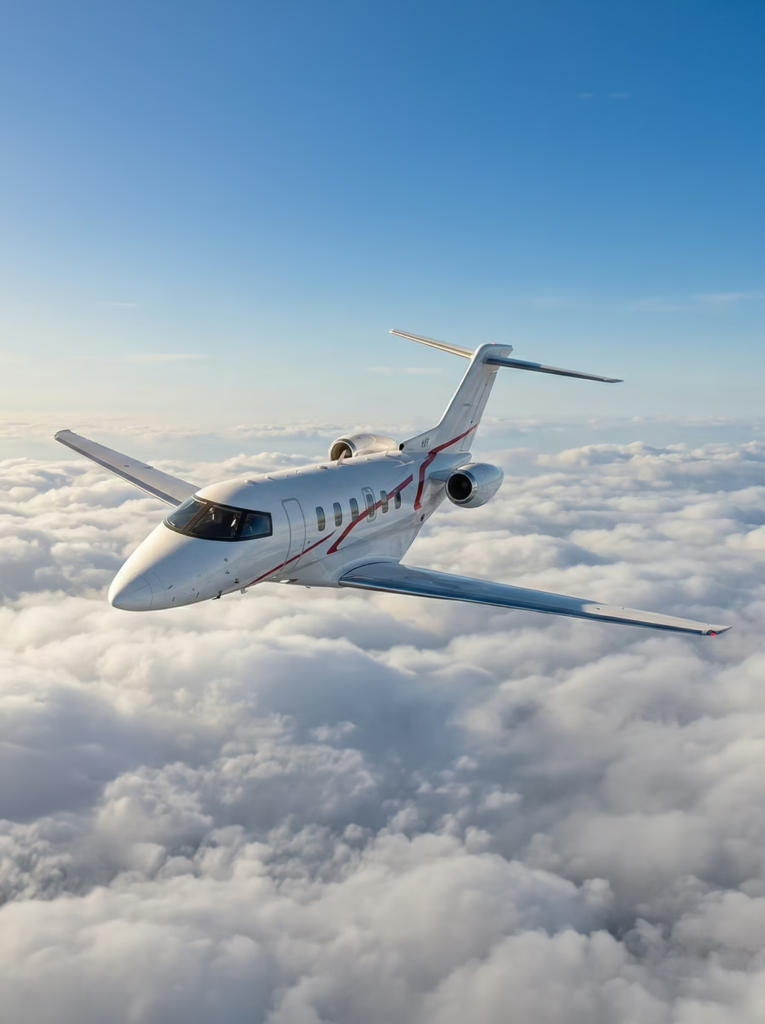
Yes, you can absolutely charter a private jet for a one-way flight. One-way private jet charters are a standard offering across the industry, and for many travellers they represent the most practical and cost-effective way to fly privately. The key distinction from commercial aviation is that you are not required to book a return leg: you pay for the routing you need, nothing more.
That said, one-way charters do carry their own pricing dynamics, largely because of how operators manage aircraft positioning. Understanding those dynamics helps you make smarter decisions about when to book a one-way flight, how to find better value, and which solutions suit your travel pattern over time.
Is a one-way private jet charter more expensive than a return flight?
A one-way private jet charter is often priced higher per flight hour than a return trip, but that does not mean it always costs more overall. On a return charter, you typically pay for both legs plus any waiting time or overnight costs for the crew and aircraft. A one-way charter eliminates those waiting costs, so the total expenditure can actually be lower depending on your itinerary.
The reason one-way pricing can feel elevated is rooted in aircraft positioning. When you fly one-way from, say, Antwerp to Milan, the aircraft and crew need to return to their base, or reposition to their next assignment, after dropping you off. That return or repositioning flight, known as a deadhead or empty leg, is an operational cost that the operator absorbs. On a return charter, that problem disappears because you are providing the return journey yourself.
For shorter routes within Europe, the difference in per-trip cost between a one-way and a return charter tends to be modest. On longer intercontinental routes, the gap widens because the repositioning cost is more significant. The practical takeaway: always request a quote for both options and compare the total cost, not just the hourly rate.
YOUR NEXT JOURNEY STARTS HERE
Speak with our team about your private aviation needs.
What is an empty leg flight and how does it relate to one-way charters?
An empty leg flight is a one-way sector that an aircraft must fly without paying passengers, typically because it needs to reposition after dropping off a client or return to its home base after a one-way charter. These flights are offered at significantly reduced rates, often between 25 and 75 percent below the standard charter price, because the operator is covering a cost they would incur regardless.
Empty legs arise directly from one-way charters. Every time a client books a one-way flight, the operator faces a repositioning journey in the opposite direction. Rather than fly that sector completely empty, operators make these available to clients willing to match the fixed routing and timing. The catch is that empty legs are inherently inflexible: the departure point, destination, date, and aircraft type are all fixed by the original charter booking.
For travellers whose plans happen to align with an available empty leg, the savings can be substantial. They work best for leisure trips where timing has some flexibility, or for corporate travellers who need to move in the same direction as the repositioning flight. If your schedule is fixed and non-negotiable, an empty leg is a less reliable option: a change to the original charter booking can cause the empty leg to be cancelled or rescheduled at short notice.
Empty legs represent one of the most compelling value opportunities in private jet charter, but they reward flexibility rather than certainty.
What factors affect the cost of a one-way private jet charter?
The cost of a one-way private jet charter is shaped by several variables working together. Aircraft type and size carry the most weight, followed by routing, positioning requirements, and the time of year.
- Aircraft category: A light jet on a short European hop costs a fraction of what a heavy or ultra-long-range jet costs on a transatlantic sector. The aircraft size you need is determined by passenger count, baggage volume, and distance.
- Routing and repositioning: If the aircraft must travel a long distance to reach your departure airport before your flight even begins, that positioning flight adds to your quote. Booking an aircraft that is already based near your departure point reduces this cost.
- Distance and flight time: Charter pricing is fundamentally tied to flight hours. Longer routes mean higher costs, with fuel, crew hours, and overflight fees all increasing proportionally.
- Airport fees and handling: Landing fees, ground handling, and passenger facility charges vary significantly between airports. Flying into a busy international hub typically costs more than using a smaller regional airfield.
- Seasonality and demand: Peak periods (ski season, summer in the Mediterranean, major European events) drive up demand and therefore pricing. Booking outside peak windows or with more lead time can improve value.
- Overnight and waiting costs: If your schedule requires the crew and aircraft to remain on standby at your destination, those overnight or waiting costs are factored into the quote.
When comparing quotes, ask your operator to break down what is included. A transparent quote will show the base flight cost, positioning fees if applicable, airport charges, and any additional services, so you can evaluate like for like.
Which aircraft types are best suited for one-way charter flights?
The right aircraft for a one-way charter depends on the distance you are covering, the number of passengers, and your baggage requirements. No single category fits every one-way mission, but understanding the main options makes it straightforward to match the aircraft to the trip.
- Turboprops are well suited to short one-way sectors, particularly when the destination is a smaller or regional airfield. The Pilatus PC-12 is a strong example, a versatile, single-engine turboprop that can access shorter runways that jets cannot use, making it a practical choice for one-way trips to destinations off the main aviation network.
- Light jets cover most intra-European one-way routes efficiently. They carry four to six passengers comfortably over distances up to roughly 3,000 kilometres, making them the workhorse category for business trips between major European cities.
- Super light jets and midsize jets offer more cabin space and range, suitable for longer one-way sectors or when passenger comfort over a three- to four-hour flight is a priority. The Embraer Praetor 600 is a midsize example with transatlantic capability.
- Heavy jets and ultra-long-range jets are the right choice for intercontinental one-way charters, transatlantic or Middle East routes, for instance, where range, cabin height, and the ability to hold meetings or sleep comfortably in flight become important.
One practical consideration for one-way charters specifically: a smaller aircraft that is already positioned near your departure point will often produce a lower total cost than a larger aircraft that needs to reposition from further away. Your charter team can advise on which aircraft in the available fleet is best placed for your specific routing.
YOUR NEXT JOURNEY STARTS HERE
Speak with our team about your private aviation needs.
When does a jet card or membership make more sense than booking one-way charters?
A jet card or membership programme makes more sense than booking individual one-way charters when you fly privately more than a handful of times per year and want guaranteed availability, price predictability, and reduced administrative friction on each trip. For occasional travellers, ad hoc one-way charters remain the most flexible and cost-efficient approach.
The core trade-off is straightforward. Individual one-way charters give you maximum flexibility with no upfront commitment: you pay for exactly what you use, when you use it. But as your flight frequency increases, the time spent sourcing quotes, comparing aircraft, and managing logistics on each booking adds up. A structured programme consolidates that process.
FLYINGGROUP’s FlyingCard membership, for example, starts at 25 flight hours per year and lets you pre-reserve hours while retaining full flexibility over routing and timing. For clients who fly regularly across Europe, whether for business meetings, family travel, or a combination of both, this kind of arrangement delivers consistent service quality and aircraft availability without the capital commitment of ownership.
A membership also tends to offer better value per hour once you cross a certain annual flight threshold. Below that threshold, one-way charters remain the smarter financial choice. The right answer depends on how many flights you realistically anticipate in a year and how much weight you place on guaranteed availability versus paying only when you fly.
If you are uncertain which model fits your travel pattern, the most useful step is a conversation with an aviation adviser who can map your typical routes and frequencies against the actual cost of each option. Reaching out to FLYINGGROUP directly is a straightforward way to get that comparison done without any obligation.